Health library
Back to health libraryOsteoarthritis: What actually damages joints?
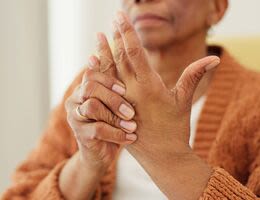
June 4, 2026—You might have heard that osteoarthritis (OA), the most common type of arthritis, is a result of years of wear and tear on the joints. While that does play a key role, there's more to how OA starts and progresses.
Around 33 million U.S. adults are living with OA, the Centers for Disease Control and Prevention reports. OA is a disease that gradually breaks down joints. It's one of more than 100 types of arthritis. Some, like rheumatoid arthritis, develop when the immune system mistakenly attacks the joints. Other common types of arthritis include juvenile arthritis, psoriatic arthritis and gout.
OA most often affects the hands, knees, hips, lower back and neck. But it can develop in any joint. The main symptoms are joint pain, stiffness and swelling. The pain often worsens with activity, and stiffness is common in the morning or after resting the joint.
Other signs and symptoms of OA include:
- A clicking or popping sound when you move a joint.
- Swelling around a joint.
- A joint that buckles or "gives out."
Beyond wear and tear
Experts now view OA as more than just the breakdown of bone-cushioning cartilage. Instead, it's recognized as a disease that affects the whole joint, including the bone, ligaments, fat and other tissues.
And, as the Arthritis Foundation reports, inflammation plays a key role in that damage. Instead of just wear and tear, excessive or abnormal stress on the joint causes cells in the joint to release substances that promote inflammation, which further damages cartilage and other parts of the joint.
There is evidence that chronic, low-grade inflammation throughout the body also contributes to joint damage in OA. Some reasons for this body-wide inflammation may include obesity (fat cells release inflammatory chemicals) and an imbalance in the gut microbiome (the mix of bacteria that live in our digestive tract).
Can you reduce your risk?
While there's no guarantee that you can prevent OA, you can help lower your chances of getting it by being aware of the risk factors&emdash;including a few you may be able to control:
Your age. Most people who have OA are older than 50.
Your body mass index (BMI). Excess pounds can put extra stress on weight-bearing joints like the knees and hips, in addition to triggering inflammation that damages joints. Keeping a healthy weight is important for maintaining overall well-being as well as healthy joints.
Overuse. OA is more common among people who do a lot of squatting, bending or other repetitive motions at work, according to CDC. This is because using the same joint over and over puts stress on it. Overuse can also occur during sports.
Joint injuries. If you've ever injured the bones, tendons or ligaments in a joint, that damage can cause OA to develop faster than it otherwise would.
Muscle weakness. Strong muscles support and protect the joints. Regular exercise may help keep your muscles strong.
Your family history. OA can run in families.
Your sex. More women than men are diagnosed with OA.
One thing that doesn't cause OA, despite what you may have heard? Cracking your knuckles. The sound you hear when a knuckle cracks is gas moving inside the joint, not a joint being damaged.
If you suspect that you might have OA, find out what your doctor thinks
If you do have arthritis, treatments and lifestyle changes may help you find relief. You shouldn't delay seeking a diagnosis. Here's what you could be risking if you do that.
Sources
- Arthritis Foundation. "Debunking Arthritis Myths." https://www.arthritis.org/health-wellness/about-arthritis/understanding-arthritis/debunking-arthritis-myths.
- Arthritis Foundation. "How to Reduce Your Risk of Arthritis." https://www.arthritis.org/health-wellness/about-arthritis/understanding-arthritis/reduce-your-risk.
- Arthritis Foundation. "Microbiome's Role in Osteoarthritis." https://www.arthritis.org/diseases/more-about/microbiomes-role-in-osteoarthritis.
- Arthritis Foundation. "Osteoarthritis." https://www.arthritis.org/diseases/osteoarthritis.
- Arthritis Foundation. "Slowing Osteoarthritis Progression." https://www.arthritis.org/diseases/more-about/slowing-osteoarthritis-progression.
- Centers for Disease Control and Prevention. "Arthritis Risk Factors." https://www.cdc.gov/arthritis/risk-factors/index.html.
- Centers for Disease Control and Prevention. "Osteoarthritis." https://www.cdc.gov/arthritis/osteoarthritis/index.html#cdc_generic_section_3-things-that-increase-the-risk-for-oa.
- UpToDate. "Pathogenesis of Osteoarthritis." https://www.uptodate.com/contents/pathogenesis-of-osteoarthritis.
- U.S. National Library of Medicine. "Arthritis." https://medlineplus.gov/arthritis.html.